
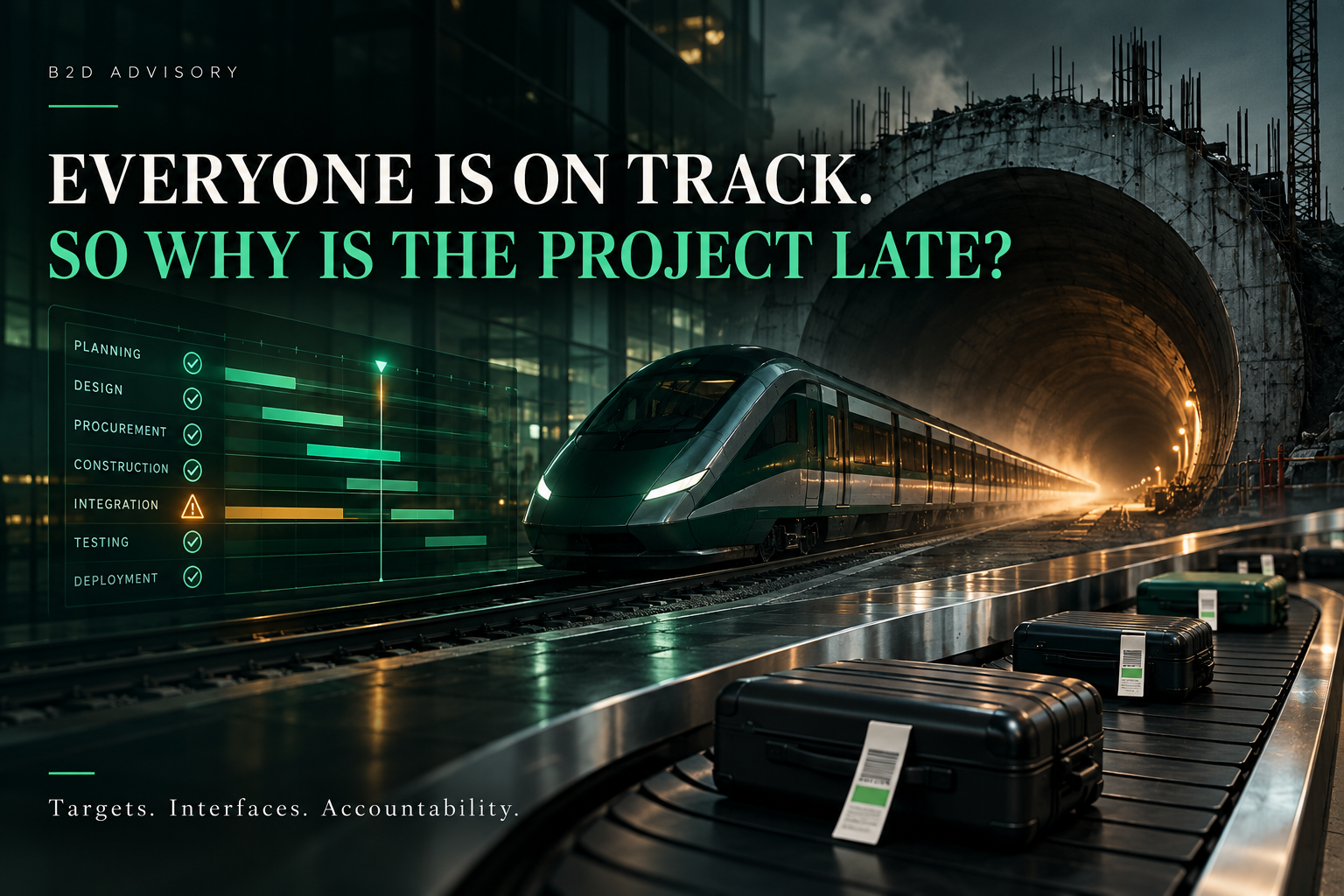
A train, an airport and a hospital system. Different projects, one uncomfortable question: who is proving that the whole outcome will work?
Crossrail: when the target outruns the forecast
In June 2018, a parliamentary committee member visited Crossrail and was told the programme was on track. Yet the independent Project Representative’s May report had identified significant completion and integration challenges. On 31 August, the December opening was postponed. Central-section passenger services eventually began on 24 May 2022.
Parliament criticised excessive optimism and failures in reporting risks. The former chair argued that retaining the deadline motivated contractors; his successor said that approach helped only up to a point and was causing problems by 2018. The dilemma: when does pressure improve performance, and when does it distort the forecast?
Denver: the dependency that held up an airport
The US Government Accountability Office reported in October 1994 that Denver’s automated baggage system had serious mechanical and software problems and had not passed the tests required for operational certification. Bags were misloaded, misrouted or fell from carts, causing jams. The problems delayed the airport’s opening; an alternative conventional system was estimated to cost $51 million.
Our interpretation: visible construction progress cannot establish operational readiness. Ask the contractor about interfaces, the operator about acceptance and the sponsor about fallback options. What is your project’s baggage system—the dependency that can prevent everything else from producing value?

NHS technology: the customer had obligations too
In 2013, Parliament reported serious delays in the Lorenzo care records system. It also found that the Department had failed to meet its contractual obligation to make 160 trusts available for deployment, weakening its ability to enforce the contract despite the supplier’s poor performance. Some other parts of the wider NHS IT programme were delivered successfully.
The commercial dilemma: before demanding supplier recovery, has the customer delivered the access, decisions, information and users it promised? Accountability runs through both sides of the contract.
Six phrases that deserve a second question
These are B2D’s general diagnostic patterns, not findings that every case used these practices or that anyone deliberately concealed information.
- “Committed to the date.” Ask for the evidence-based forecast, remaining work and uncertainty.
- “95% complete.” Ask whether testing, commissioning and acceptance are included.
- “Our package is complete.” Ask who owns the unresolved interfaces.
- “The vendor is responsible.” Check overdue customer and third-party obligations.
- “The revised plan is approved.” Compare original, revised and forecast dates together.
- “We will recover next month.” Ask what changes in resources, access or productivity make recovery credible.
Take the sponsor’s chair
Fictional exercise: construction is reported as 95% complete, opening is twelve weeks away, integrated testing has not passed, and the supplier awaits customer approvals. What do you do first?
Choose an option to examine its tradeoffs. No votes or personal data are collected.
Acceleration can help when the constraint is understood. Funding alone may increase rework if approvals or integration remain blocked. Establish the bottleneck before authorising more spending.A readiness review can expose missing acceptance evidence and dependencies. It needs a clear remit, access to evidence and prompt decisions; another report alone will not unblock delivery.Removing customer blockers and rebuilding the integrated forecast addresses key dependencies. It still requires testing evidence, contractor commitments and sponsor decisions about the opening date.A deadline tells people what you want. A forecast tells you what the evidence supports. Governance needs both.
Before the next review: sponsor—separate ambition from forecast; project team—show remaining work; customer—clear obligations; vendors—demonstrate interfaces; independent reviewer—challenge unsupported assumptions.
B2D connects bid decisions, commercial obligations and delivery controls. An independent review can clarify exposure and options; it cannot guarantee an outcome.
Discuss your project with B2DSources and editorial notes
Historical case evidence is linked below. Lessons and the fictional exercise are B2D analysis. These cases do not establish that all parties were on track, that every dashboard was green, or that delays had a single cause.
- UK Parliament — Crossrail: progress review, conclusions (2019)
- UK Parliament — Crossrail: delays and cost overruns (2019)
- UK Parliament — Completing Crossrail: optimism and schedule (2019)
- London Assembly — Crossrail delay report (2019)
- Bechtel — Elizabeth line opening date; project participant account
- US GAO — New Denver Airport: Impact of the Delayed Baggage System (14 October 1994)
- UK Parliament — The dismantled National Programme for IT in the NHS (2013)
Related reading: Denver, tender requirements and engineering rework