
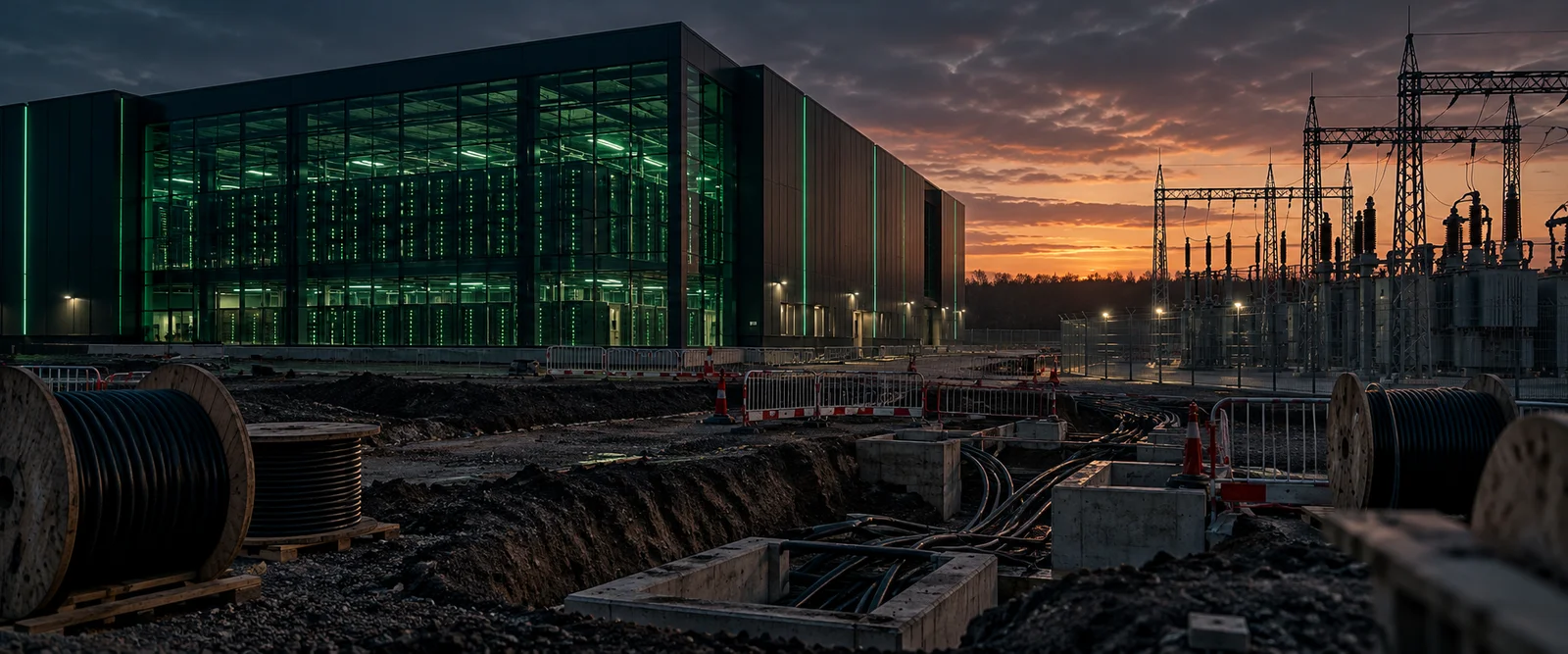
Who approved your completion date—and did the people supplying your electricity, permits and equipment agree to it?
A budget can buy construction. It cannot, by itself, secure the permissions, infrastructure or decisions that make an asset usable. This week’s energy research—and two recent project updates—make that distinction difficult to ignore.
The money is there. The readiness may not be.
On 27 October, Jacobs published a survey of 600 senior energy-sector decision-makers across five countries. While 71% believed sufficient industry capital was available, only 29% saw both enough capital and enough investable projects. Infrastructure outside their direct control was a major or critical constraint for 57%. These are respondents’ assessments, not measured project failure rates.
The customer can leave before the power arrives
Reuters reported on Microsoft’s withdrawal from its anchor-customer agreement for Nscale’s Loughton data centre after expected electricity availability moved into the 2030s. The report was published on Investing.com on 20 October. Both companies said their wider partnership continued; Nscale said it remained committed to the site and was exploring alternative power.
B2D’s interpretation: the commercial clock and the infrastructure clock must agree. This report does not establish which parties knew what at approval, or who breached an obligation. It does show how an external dependency can affect a customer commitment.
When the estimate meets the unfinished design
On 22 October, Snowy Hydro announced a revised Snowy 2.0 target cost of A$22.2 billion, allowing for an A$25 billion scenario, and full commissioning in late 2029. Its stated causes included immature design at investment decision, construction complexity, productivity and planning underperformance, and escalation. The company also reported stronger oversight and continued long-term benefits.
This is a different mechanism from a missing power connection. The common lesson is to test whether the evidence behind a commitment is mature enough. A funding decision cannot remove technical uncertainty.

Five people, five uncomfortable questions
- Sponsor: what evidence would make us refuse to commit today?
- Project team: which external milestones control the earliest usable completion date?
- Customer: how long does the project remain valuable if opening moves?
- Contractor and suppliers: who controls each dependency, and what commitments support the schedule?
- Finance team: what happens to liquidity when spending continues but revenue starts later?
Take the investment committee’s chair
Fictional scenario: funding and a customer are secured. Construction takes 18 months, but the utility forecasts connection in 30 months. What do you approve?
Choose an option to reveal its trade-offs. This exercise collects no votes or personal data.
Building now may preserve capacity, but creates a possible 12-month idle period. Check equipment storage, warranties, financing and whether the customer can wait. Acceleration only helps if it changes the controlling dependency.Conditional enabling work can preserve options. Set a spending ceiling, connection evidence, an accountable owner and a decision deadline. Conditions must prevent automatic escalation into full commitment.Pausing can protect capital while alternative sites, power arrangements or phasing are assessed. It can also lose capacity or the customer. Compare the cost of waiting with the cost of building too early.How to stop the waiting room becoming your project
1. Map dependencies before commitment. Record power, water, permits, access, design and equipment, with evidence, owner and required date.
2. Build one integrated schedule. Include third-party milestones and commissioning; test the effect of a three-, six- and twelve-month delay.
3. Make approvals conditional. Release spending in stages against documented readiness, with clear pause and escalation triggers.
4. Align commercial obligations. Examine customer dates, utility commitments, supplier reservations, warranties and remedies together. A contract can allocate consequences; it cannot create missing capacity.
5. Recheck the business case. Update cash flow, funding headroom and the value of remaining work when assumptions change. Decide whether to proceed, phase, relocate or pause.
B2D can help connect the dependency register, delivery schedule and commercial commitments into a readiness review—so the next investment decision is supported by evidence.
Discuss your project with B2DSources and editorial notes
The numbered links identify reported facts. Questions, recommendations and the fictional exercise are B2D analysis. The cases have different causes; no single source establishes a universal explanation for project delay.