The supplier’s name stays the same. Its way of delivering your service may have changed.
An AI agent is software that can use tools and perform tasks across systems. Depending on its permissions, it may do more than produce an answer: it can update a record, trigger a workflow or send a message. The business question is what authority accompanies those actions.
The gap is already visible
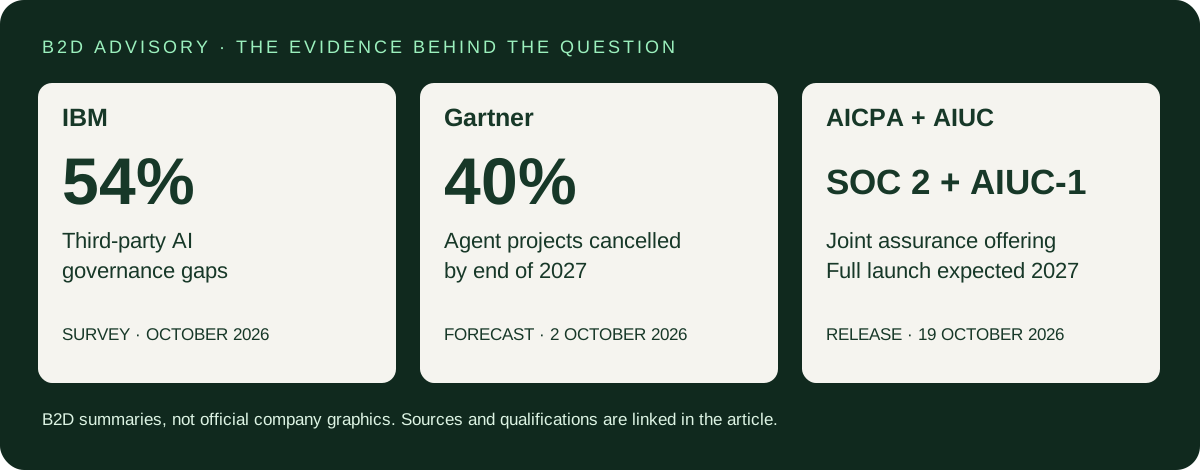
IBM’s October research surveyed 3,221 executives at large organisations in eight countries, including Saudi Arabia and the UAE. It found that 54% acknowledged gaps or limitations in governance covering AI used by key vendors, technology partners and supply-chain participants. Only 21% reported continuous monitoring of third-party AI risk. These are survey responses, not findings that those suppliers breached contracts.
In a separate announcement dated 27 October, IBM described agent identity, access controls and evaluation capabilities. Some capabilities were generally available and others were previews. This is a vendor announcement, not independent proof of effectiveness. Its relevance is the business requirement it addresses: identifying an agent, limiting its access and being able to revoke that access.
Visual source briefing
The demonstration is not the delivery model
Gartner’s 2 October analysis predicts that 40% of agentic AI projects will be cancelled by the end of 2027 because of rising costs, unclear value or inadequate risk controls. That is a forecast, not an observed cancellation rate. For buyers, it reinforces a practical question: what happens after the impressive demonstration?
A supplier may improve its service through automation. The opportunity is real: faster processing, more consistent records and less repetitive administration. But buyers still need evidence that the changed workflow meets their requirements. Productivity claims alone do not establish confidentiality, approval authority or reliable recovery.
Assurance is becoming part of the buying conversation
An AICPA and AIUC release datelined 19 October describes a joint offering combining a SOC 2 report with AIUC-1 certification. The release says a full launch is expected in early 2027. This signals a developing route to independent assurance; it does not make certification universal, mandatory or a guarantee against failure.
B2D’s interpretation: buyers need to evaluate the service, the automation behind it and the evidence supporting both. A certificate can inform due diligence, but its scope, date and exclusions still matter.
Before the next supplier review
- Procurement: ask where AI is used in your service, which providers are involved and what materially changes when the supplier changes its tools.
- Project team: identify the records, dates and instructions that people may rely on. Decide which automated outputs require confirmation before they enter the baseline.
- Commercial team: make permitted tasks, approval thresholds, change notification and incident escalation explicit. Review responsibility, evidence access and recovery arrangements with qualified advisers for the relevant contract and jurisdiction.
- Technology team: match system permissions to those agreed boundaries. A contractual restriction without an enforceable access limit may leave a practical gap.
- Leadership: name the person who owns the service outcome. Do not leave the project team, supplier and technology function each assuming another party is watching.
A supplier AI review should end with decisions
Create a short, service-specific register: the agent’s purpose, owner, systems and data, permitted actions, human approval points and suspension process. Ask for test evidence against your actual workflow and a fallback if the automated service becomes unavailable.
Then connect that register to procurement requirements, acceptance testing and ongoing reviews. Reassess after material changes. B2D can help coordinate the commercial and delivery work alongside specialist technical and legal advisers. The goal is useful automation with clear authority and measurable service outcomes.
Your turn: would you rely on this confirmation?
Fictional exercise. These scenarios do not describe IBM, Gartner, AICPA, AIUC or any named supplier. No votes or personal data are collected.
Sources and editorial notes
Reported research and announcements are linked below. Recommendations and scenarios are B2D analysis, not findings of wrongdoing by the named organisations. Source dates are shown so readers can distinguish current announcements from forecasts.
- IBM / Censuswide — EMEA AI governance survey (page dated 14 October; release datelined 15 October 2026)
- IBM — Agent identity and control announcement (27 October 2026)
- Gartner — AI agent reliability and autonomy analysis (2 October 2026)
- AICPA & CIMA / AIUC — Joint assurance offering (page dated 18 October; release datelined 19 October 2026)